1. Tempered Glass Doors
The defining feature of tempered glass doors is their exceptional mechanical strength and ability to withstand heavy loads.
- Superior Impact Resistance: Tempered glass is approximately four to five times stronger than ordinary glass of the same thickness. It offers outstanding resistance to impact, wind pressure, and vibration, making it ideal for both residential and commercial applications.
- Enhanced Safety Upon Breakage: If subjected to an impact that exceeds its design strength, tempered glass shatters instantly into small, blunt-edged granules rather than sharp, jagged shards. This significantly reduces the risk of serious injury and enhances user safety.
- Excellent Thermal Shock Resistance: Tempered glass can withstand sudden temperature changes of approximately 150°C to 200°C (302°F–392°F) without cracking or breaking. In comparison, ordinary glass typically fractures when exposed to a temperature difference of around 50°C (90°F).
- Limitations: While tempered glass provides excellent strength and safety, its thermal insulation and sound insulation are only moderate. In addition, once the glass has been tempered, it cannot be cut, drilled, or edge-ground, as any further processing will cause it to shatter.
2. Laminated Glass Doors
The core advantage of laminated glass doors is their enhanced security and superior on-site safety.
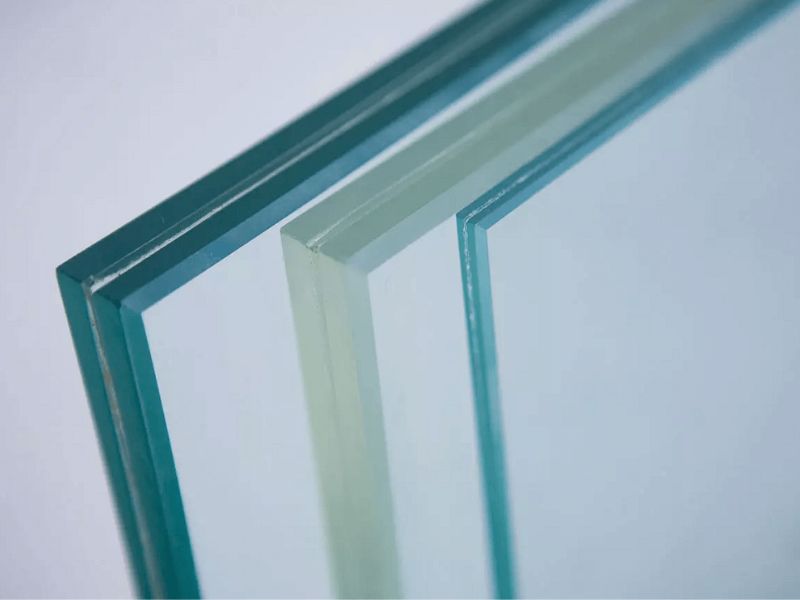
- Shatter-Resistant Safety (Continuous Protection): Thanks to the PVB (Polyvinyl Butyral) interlayer, if the glass is broken, the fragments remain firmly bonded to the interlayer instead of falling out of the frame. This creates a protective barrier that helps prevent falls, injuries, and object penetration.
- Burglary and Forced-Entry Resistance: Laminated glass is much more difficult to penetrate than ordinary glass. Even when cracked, the tough interlayer continues to hold the glass together, significantly increasing the time and effort required for forced entry while generating considerable noise.
- Excellent Sound Insulation: The PVB interlayer acts as an acoustic dampening layer that absorbs sound vibrations, providing significantly better noise reduction than a single pane of tempered glass.
- UV Protection: The interlayer blocks up to 99% of harmful ultraviolet (UV) rays, helping protect occupants' skin while preventing furniture, flooring, curtains, and other interior furnishings from fading due to prolonged sun exposure.
-
3. Insulated Glass Doors (Insulating Glass Units – IGUs)
The defining feature of insulated glass doors is their exceptional thermal insulation and acoustic performance.
- Superior Sound Insulation: The sealed cavity filled with argon gas (or another inert gas) between the glass panes significantly reduces outside noise, typically by 30–50 dB. This makes insulated glass an ideal solution for homes and buildings located near busy roads, airports, railways, or other noisy environments.
- Outstanding Thermal Insulation and Energy Efficiency: The inert gas layer is a poor conductor of heat, minimizing heat transfer between indoor and outdoor environments. It helps keep interiors cooler during summer and warmer during winter, reducing the workload on air conditioning and heating systems.
- Condensation Prevention: During cold weather or when air conditioning is used, temperature differences can cause condensation to form on ordinary glass. Insulated glass units contain a desiccant-filled spacer that absorbs moisture within the sealed cavity, preventing fogging and ensuring the glass remains clear.
- Installation Considerations: Because insulated glass units are thicker and heavier than standard glass, they require high-quality aluminum framing systems—such as thermally broken aluminum frames—along with heavy-duty hardware capable of supporting the additional weight.
-
4. Low-E (Low-Emissivity) Glass Doors
The primary advantage of Low-E (Low-Emissivity) glass is its ability to control solar heat radiation while maximizing natural daylight. For optimal performance, Low-E glass is commonly manufactured as part of an Insulating Glass Unit (Low-E IGU).
- Smart Solar Heat Control: Low-E glass is coated with multiple ultra-thin metallic layers, including a microscopic silver (Ag) coating, which acts as a thermal reflector. It allows visible light to pass through while reflecting infrared radiation—the primary source of solar heat—thereby reducing heat gain and minimizing the greenhouse effect inside the building.
- Stable Indoor Temperature: During colder seasons, the Low-E coating reflects indoor heat back into the room instead of allowing it to escape through the glass, helping maintain a comfortable indoor temperature throughout the year.
- Long-Term Energy Savings: Low-E glass is one of the most energy-efficient glazing solutions available. It can reduce heating and cooling energy consumption by up to 40–50%, resulting in substantial long-term savings on electricity and HVAC operating costs.
- High Visible Light Transmission: Unlike conventional reflective glass, which often darkens interior spaces, Low-E glass provides excellent natural daylight while effectively reducing unwanted solar heat, creating bright, comfortable, and energy-efficient living and working environments.